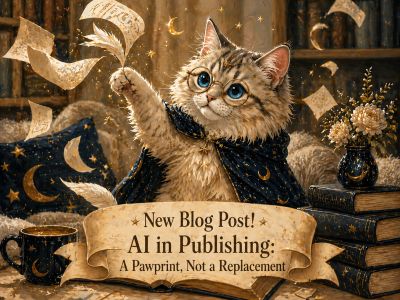
Welcome to Northlight kitty's blog
Northlight Kitty is Northlight Publishing House’s Chief Book Discoverer. On her blog, she shares useful advice for writers and keeps an eye on what is happening in publishing, with the occasional update from Northlight itself.
Publishing Tips and Insights from Northlight Kitty
By Northlight Kitty, Chief Book Discoverer at Northlight Publishing House
Curl up, dear writers. We need to talk about the very clever, slightly chaotic, always-available creature sitting in the corner of the modern writing room: Artificial intelligence.
Some people glare at it as if it has tracked muddy pawprints across a clean manuscript, while others treat it like a magic wand that can produce a book with one prompt and a dramatic flourish. But Northlight Kitty believes the truth sits somewhere warmer, wiser, and more useful.
AI is here, and it is not going away. As technology grows, it will become increasingly common in the ways we learn, write, edit, publish, market, and read in the publishing industry.
So perhaps the question is no longer, “Should writers use AI?” The better question is: How do writers use AI honestly, thoughtfully, and without losing the human heart of the story? At Northlight Publishing House, my view is simple: AI can be a helpful companion, but it should not be the author.
A writer may use AI to check typos, improve sentence flow, catch grammar slips, organize ideas, brainstorm possibilities, or move through a stubborn patch of writer’s block. That, to me, is not cheating; that is using a tool—one to which author inspiration can spring forth.
English is a difficult language. Writing is a challenging skill. Not every storyteller has had the same education, confidence, resources, or relationship with the language in which they are writing. None of that should stop someone from telling their story.
I believe everyone has at least one book in them. AI can help some people reach the page, especially when the blank page feels too loud. It can offer structure, suggestions, a spark, or a second opinion, which does not make the story fake or the author less worthy. It simply means the author accepted help. And writers have always accepted help—they have used dictionaries, thesauruses, spellcheckers, critique partners, writing groups, editors, proofreaders, ghostwriters, agents, beta readers, workshops, notebooks, coffee, tears, and the occasional dramatic stare out of a rain-covered window.
Publishing has never been a purely solitary act. The myth of the lone genius scratching perfect sentences onto paper is charming but incomplete. Books have always been shaped by many hands. AI simply adds a new kind of helper to the room.
But here is where Northlight Kitty draws a very clear pawprint in the dust: AI should not replace the human seed of the story. A book generated entirely from a prompt may contain chapters, characters, dialogue, and a tidy ending. But a story— a real story—comes from somewhere deeper. It derives from memory, longing, pain, wonder, mischief, grief, hope, curiosity, and lived experience. It comes from the human being who has something to say, even if they need help finding the words.
That is why authors should not feel ashamed to say: AI helped me brainstorm. AI helped me untangle a chapter. AI gave me options I rejected. AI helped me see another path. AI sat with me when the blank page felt too loud. AI was my most intelligent friend, and occasionally my most irritating one.
That honesty should not be treated as a confession. It should be treated as transparency in writing tips. There is a difference between a writer using AI as a thoughtful assistant and someone asking AI to manufacture a book while they stand back and claim the soul of it. The difference is human authorship. The difference is creative decision-making. The difference is whether the writer remains responsible for the work.
Editors matter here more than ever. A good editor does not simply fix commas and move paragraphs around; a good editor listens for the author’s voice. They know when a sentence is clumsy but alive, when a scene is messy but emotionally true, and when a character has wandered off the path yet is carrying the heart of the book in their paws.
AI can help with the heavy lift. It can speed up workflow. It can identify patterns. It can offer suggestions and can be useful, especially at the early and technical stages of writing in the publishing industry.
But AI cannot replace the essential human element between author and editor: trust. It cannot understand an author’s quiet fear that the book is not good enough. It cannot celebrate the moment a chapter finally clicks. It cannot know when a story needs gentleness instead of efficiency. It cannot look at a manuscript and say, “There you are. That is the book you were trying to write.” That is the editor’s work. And that is the author’s journey.
The publishing world now has serious questions to answer. How should AI use be disclosed? What counts as assistance and what counts as generation? How do we protect authors’ copyrighted work? How do we preserve trust with readers? How do we make room for new writers who have grown up with AI as part of how they study, learn, draft, and think?
These questions deserve care, not panic.
The stalwart dinosaurs of the writing world may look down their spectacles at emerging authors who use AI tools, but perhaps they should remember that every generation of writers has been accused of ruining literature. The typewriter was once suspicious. The word processor was once suspicious. Spellcheck was suspicious once. The internet was certainly suspicious. And now, apparently, the em dash has become evidence of robotic mischief.
Which is very funny, because writers have been flinging em dashes across the page for centuries like confetti at a literary wedding. Jane Austen used them. Charles Dickens used them. Emily Dickinson practically built a house out of them. Herman Melville, George Eliot, and many others were not exactly waiting for a chatbot to teach them dramatic punctuation.
So no, dear reader, we are not surrendering the em dash. You may pry it from our cold, ink-stained paws. If you want to remove every em dash from your manuscript because you are afraid someone will think you spoke to your most intelligent friend while writing your book, that is your choice. Northlight Kitty supports your punctuation journey.
But the rest of us will be over here using punctuation with flair, technology with honesty, and creativity with courage.
AI is not the end of authorship. It is a challenge to define authorship more clearly. It asks us to be honest about process, respectful of copyright, transparent with readers, and generous toward writers who need support. It asks editors to become sharper, not obsolete. It asks publishers to build ethical guidelines instead of pretending the future can be shooed away with a rolled-up newspaper.
Most of all, it asks us to remember what a book truly is. A book is not just text. A book is a voice reaching for another voice. A book is a human signal sent through time. A book is someone saying, “Here is what I carried. Here is what I imagined. Here is what I survived. Here is what I dreamed.”
AI may help arrange the pages. But the story still has to come from the storyteller. And that, dear writers, is something worth protecting.
With whiskers, wonder, and one very well-placed em dash,
Northlight Kitty
29 April 2026